
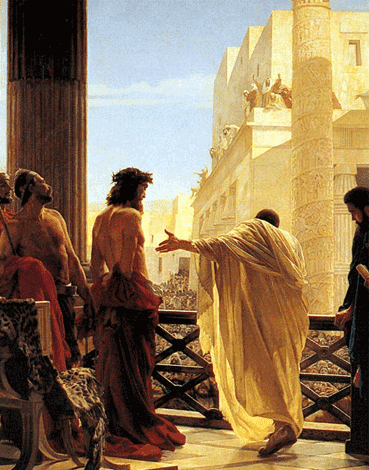
Around 2,000 years ago Pontius Pilot stood in front of the Creator of the Universe–Jesus Christ–and was tasked with the responsibility of deciding if Jesus should be crucified.
Pilot wanted nothing to do with this situation. His own wife had warned him–based on a terrible premonition–against being involved in executing Jesus. On top of that, Pilot believed Jesus was innocent. Pilot did his best to wiggle out of the situation, but he couldn’t, and in the end he didn’t have the backbone required to go against the angry mob.
But, before the mob got its way, while Pilot was questioning Jesus, there was a moment which has always “lingered in the air” for me, let’s take a look at it:
In John 18:37 & 38 Jesus told Pilot, “...In fact, the reason I was born and came into the world is to testify to the truth. Everyone on the side of truth listens to me.”
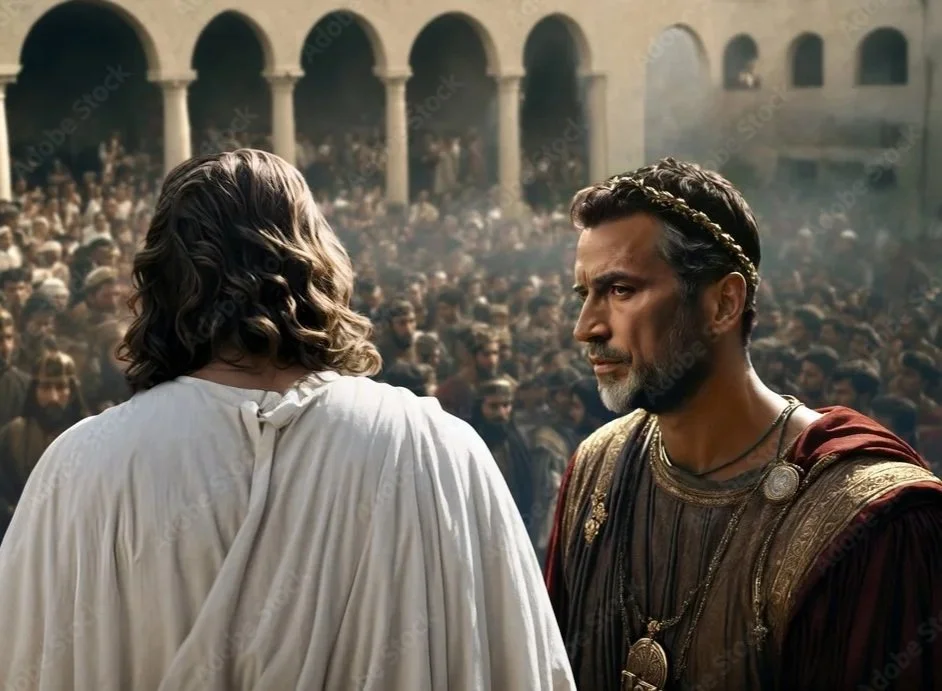
Pilot–who I assume was exhausted and exacerbated–responded by dismissively uttering the words, “What is truth?” And then he left the room.
Oh how I wish for his sake that he had waited for an answer.
It is easy to get frustrated with Pilot. He was too distracted to realize the opportunity he had; too blind to understand that he was speaking to God.
But it’s important to realize Pilot has not been the only one to make this mistake, this dismissive statement has been restated countless times throughout human history.

Thanks to my parents, I grew up studying apologetics (the search for facts to determine what truth is). Because of this I follow a lot of apologetics groups on social media. They have tons of insightful, fact and proof-filled videos answering all sorts of questions regarding faith, the Bible, Christianity, and God. And it never fails that within the comment section of these videos, someone will utter Pilot’s sentiment—”What is truth–how can we possibly know what is true?”

It makes me want to scream, “This video you are commenting on literally just clearly and plainly laid out a logical argument pointing you to the truth! Open your eyes, open your ears, listen and learn!”
They may not be standing face to face with the Creator and arbiter of truth like Pilot was, but they are being just as deliberately blind. They act as if the truth is too hard–if not impossible–to discover.

Our God is a God of reason and logic. All of existence from the tiniest of atoms to the largest of galaxies is pieced together like a fine-tuned clock, ticking away in beautiful precision. Nature is orderly and predictable. God also gave us brains and the ability to think and discover the ways in which He ordered things to work. For example, people discovered the laws of physics and mathematics (they didn’t create them).
Truth exists, reality can be discovered and understood, our universe is built on a solid foundation of fact–if I throw an apple into the air it will fall back down to the ground. And God gave us everything we need in order to discover these truths.
Furthermore, He is also a God who wants us to know Him–otherwise He wouldn’t have bothered to provide the Bible and He definitely would not have ever degraded Himself so fully by becoming a human being and allowing us to crucify Him.

To utter the words, “What is truth?” but to refuse to put any effort into actually seeking out the truth while mocking the people who do, is human hubris at its finest.
Proverbs 1:22 (NIV), “How long will you who are simple love your simple ways? How long will mockers delight in mockery and fools hate knowledge?”
God has not hidden truth from us, instead, He is calling out to us offering to hold our hands and guide us to truth.
John 10:27 (NIV), “My sheep hear my voice, and I know them, and they follow me.”
James 1:5 (NIV), “If any of you lacks wisdom, you should ask God, who gives generously to all without finding fault, and it will be given to you.”
Unfortunately, even amongst Christians we have created pitfalls to keep people from learning and fully understanding the truth.

Many people have been taught to fear any tiny bit of doubt about God, they have been threatened with the idea that asking questions means they do not have faith. This approach has left them with a “house built on sand” and when the storms come they get swept away.
In her book, “Another Gospel?”, Alisa Childers says, "Biblical faith is not a blind leap; it involves knowledge--that God has spoken and is trustworthy. False definitions of faith that are so often taught are based on a misunderstanding of the difference between unbelief and doubt. They are not the same thing. Unbelief is a decision of the will, but doubt tends to bubble up within the context of faith…Biblical faith is trust–and that trust is based on evidence."
Doubts will happen. When doubts arise, we don’t need to be afraid to seek out the answers. I would even argue that as Christians we are called to seek out these answers and be ready to provide them to anyone else who also ends up facing the same questions.
1 Peter 3:15-16 (NIV), “But in your hearts revere Christ as Lord. Always be prepared to give an answer to everyone who asks you to give the reason for the hope that you have. But do this with gentleness and respect, keeping a clear conscience, so that those who speak maliciously against your good behavior in Christ may be ashamed of their slander.”
2 Timothy 2:15 (NIV), “Do your best to present yourself to God as one approved, a worker who does not need to be ashamed and who correctly handles the word of truth.”
Colossians 2:8 (NIV), “See to it that no one takes you captive through hollow and deceptive philosophy, which depends on human tradition and the elemental spiritual forces of this world rather than on Christ.”
To end this message I would like to point out that even though it is frustrating that Pilot did not wait for Jesus to tell him what truth is, Jesus had thankfully already answered that question and we have access to His answer in John 14:6 (NIV):
“Jesus answered, ‘I am the way and the truth and the life. No one comes to the Father except through me.’”
If you’re feeling even a little bit convicted by this but don’t know where to start, I have compiled some useful information at kcmifm.com/bibleinfo. At this website you will find things you can read, listen to, and watch which will help to answer some of the common questions which are brought up about religion, including: Why believe God exists? Is the Bible the Word of God? Why believe the Bible over other religions? Does the Bible align with history and archaeology? Did Jesus rise from the dead? Have Biblical prophecies come true? If the Bible is true and it says God loves us, why do bad things happen?
This series of blog posts titled, “Holding on to Reason”, is named after Amanda’s favorite C.S. Lewis quote: “Faith is the art of holding on to things your reason has once accepted, in spite of your changing moods.”