
A huge pitfall amongst Christians comes from the fallacious idea that if one does not qualify for a specific position or place in God’s work, that this means God does not love us or value us as much as He loves and values others.

Alexander Morton Blade “Flames of Jealousy-Abstract”
I’ve seen it time and time again: a Christian sets their eyes on a specific career, mission field, or type of life and they believe with all of their heart that this is what God wants for them. But, God puts up walls and prevents them from following that plan. Then, this Christian takes it personally, they get heartbroken, they wonder why God doesn’t want to include them in His work, they let this negatively affect their relationship with God.
This mentality is not Biblical, it is a worldly, self-centered mentality. We are called to have faith in God and His plan; this includes when His plan does not make sense to us. God has proven through the cross and numerous other ways that He loves us, it’s dishonest to forget everything He has done for us when things don’t go the way we think they should. God sees the big picture and knows things we could not even fathom. If He steps outside of “our plan” and “our understanding” we are supposed to trust Him to guide us in the right direction, not question Him.

Our world muddies the waters of the Christian walk by teaching us that we should strive to be seen as the best–not actually be the best but to be seen as it. This means that positions of authority or high visibility amongst Christians are desired while other less visible positions are looked down upon. We are all taught by the world around us to portray “main-character energy”, to be the lead in the play–the Mary or Joseph of the Christmas pageant, not just a random shepherd.
This puts us out-of-line from God’s viewpoint. Did God view the shepherds as less-than, as “just another shepherd”? No, He makes that clear time and time again throughout the Bible. He loves all of His children equally and He has a role for each of us to play in His plan, a role which fits our specific skills and personality best. We just need to be willing to accept who we are and the roles God gives us, and to stop yearning for someone else’s role or to be someone else.

We are each a piece of a puzzle with God being the designer. Placing a puzzle piece in the wrong spot will not only harm the puzzle as a whole but it will also harm the puzzle piece itself as it gets squished and folded into a position it was not designed to fit into.
As God says in 1 Corinthians 12:4-7 (NIV):
“There are different kinds of gifts, but the same Spirit distributes them. There are different kinds of service, but the same Lord. There are different kinds of working, but in all of them and in everyone it is the same God at work. Now to each one the manifestation of the Spirit is given for the common good.”
The unfortunate truth is we do live in a sin-cursed world, and we all have our own personal flaws which we are meant to be working through with the help of the Holy Spirit. And there are some sin struggles which do disqualify us from certain types of ministry–but it’s never all types of ministry. God is so loving and so powerful that He works through all of us flawed people in various, appropriate ways. These flaws, along with the spiritual gifts God gives us, are all taken into account when God makes His plan for our lives. It’s important to remember how great of an honor it is to play a part in God’s plan, no matter which part we get to play.
I want to focus on a couple of real life examples of how this truth could play out.
First, let's take a look at King David:
King David, was the man whom God declared to be, “after mine own heart” (Acts 13:22; 1 Samuel 13:14), the man who as a youth had so much faith in God that he slayed the giant Goliath, the man who was arguably the greatest king the nation of Israel ever had. One day this heroic man whose name has echoed throughout history was sitting in his castle and realized the Ark of the Covenant was still sitting in a tent. He decided this was not right and so he told Nathan the Prophet that he would like to build a temple.
At first Nathan also thought this was a good idea, but then God intervened and told Nathan that David shouldn’t be the one to build a temple because he “was a warrior and had too much blood on his hands”, and the temple was meant to be a “House of Peace”.

When I first read this I couldn’t help but be confused and feel like it was unfair. After all, most of the blood David shed was in service to God. The first human David ever killed was Goliath and that was done with God’s help because of David’s faith and in order to save the nation of Israel. David is viewed as a hero for doing so. David slayed hundreds of thousands of men with his own hands, and even more through orders as king. Furthermore, his success as a warrior was only because God helped him to succeed. In many ways it was God who put David into the position of “warrior”.
Of course David did make some big mistakes like when he decided to order Bathsheba’s husband killed. But, it doesn’t seem like that specific reason is why God disqualifies David from building the temple because God told him the reason was he was a “warrior and had too much blood on his hands” not because he was a “sinner with unjust blood on his hands”.

I fully expected David to complain about God’s decree, to ask more questions, to wonder if God really loved him, to feel ripped off. To ask, “Was I wrong to kill Goliath? Is it bad to be a warrior? No? Then why am I being punished for it?” But, David doesn’t do any of that, he doesn’t view God’s decision as a punishment or as a chastisement. David doesn’t appear to react negatively at all, instead he accepts the reality of the situation–of who he is and his place in God’s plan. Then David does what he can to prepare things for his son Solomon to build the temple and continues on doing the jobs that God has assigned to him.
We can see how he reacts to all of this when he addresses the nation of Israel about it in 1 Chronicles 28:2-7 (NIV):
“King David rose to his feet and said: ‘Listen to me, my fellow Israelites, my people. I had it in my heart to build a house as a place of rest for the ark of the covenant of the Lord, for the footstool of our God, and I made plans to build it. But God said to me, ‘You are not to build a house for my Name, because you are a warrior and have shed blood.’ Yet the Lord, the God of Israel, chose me from my whole family to be king over Israel forever. He chose Judah as leader, and from the tribe of Judah he chose my family, and from my father’s sons he was pleased to make me king over all Israel. Of all my sons—and the Lord has given me many—he has chosen my son Solomon to sit on the throne of the kingdom of the Lord over Israel. He said to me: ‘Solomon your son is the one who will build my house and my courts, for I have chosen him to be my son, and I will be his father. I will establish his kingdom forever if he is unswerving in carrying out my commands and laws, as is being done at this time.’”
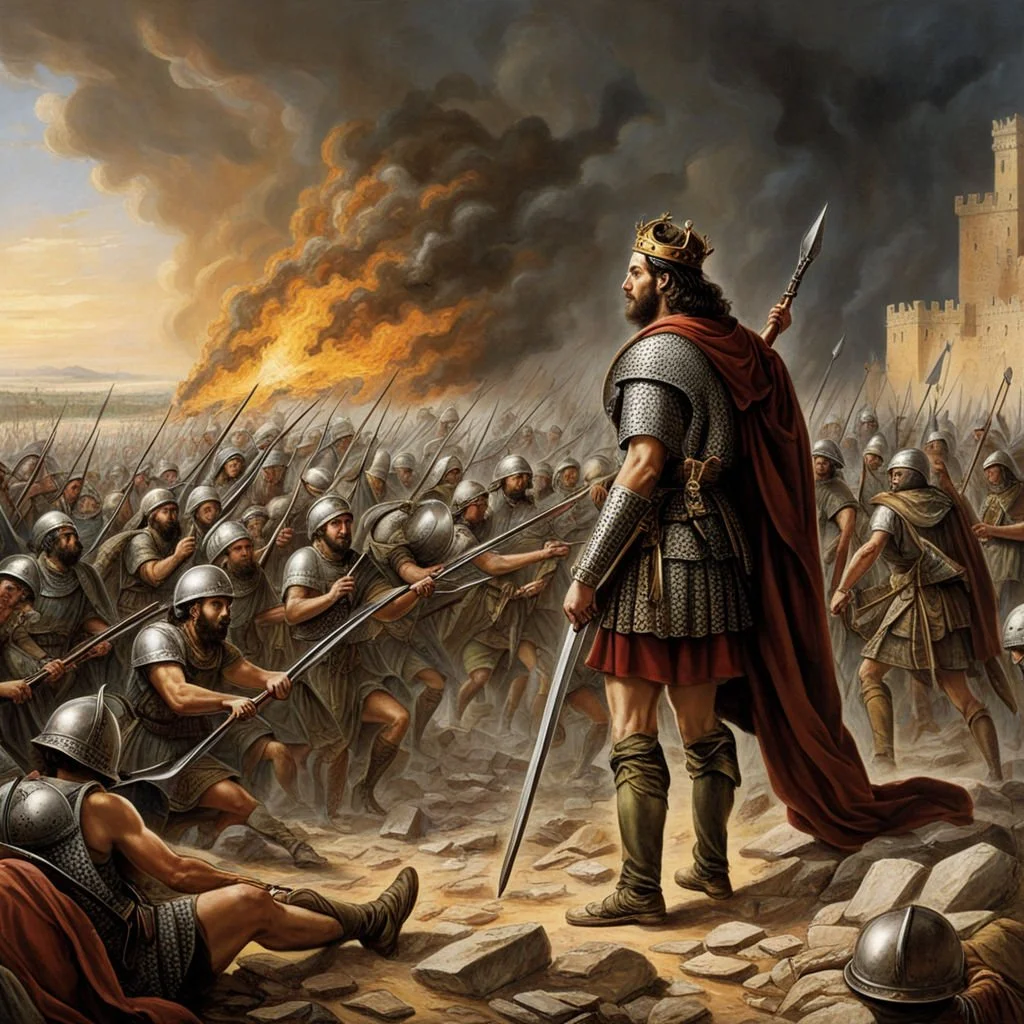
David doesn’t take it personally that God says he is not the man for this specific job, instead he falls back on the knowledge that God has given him plenty of other jobs and he humbly complies with God’s decision. David doesn’t even try to keep it a secret that God said he was wrong for the job, he tells everyone about it so that they would be ready to properly support Solomon as he builds the temple, and then David continues to work at his own role in God’s plan.
The other real-life example I want to give is my own father:

My dad came to a saving knowledge of Jesus later in life, when I was around five years old. After he had accepted Jesus as his Savior he drastically changed. He stopped drinking alcohol, worked at giving up gambling (eventually succeeded), studied apologetics, and had a huge part in leading many people to the Lord. He drove trains for the railroad but, after interacting with him, kids I went to school with always assumed he was a pastor. He was a strong and bold, seemingly fearless, servant of God. And, yet, he was never an elder or a deacon at our church.
Why not? Because he had a bad temper.
1 Timothy 3:1-7 lists the qualifications of an elder and amongst those are: he must exercise self-control, he must not be violent, he must be gentle, not quarrelsome.

Oftentimes, my dad’s temper was valid, he was justifiably angry. But the way he acted when his temper flared up wasn’t always Godly. At one point he even got into a public fist fight with a man over injustices inflicted upon my younger sister’s traveling basketball team. My dad was right to defend my sister and her friends, but if he had been walking with the Holy Spirit at that time, he most likely could have found a way to stand up for what was right without allowing the situation to become so violent.
My dad was asked to be an elder at least once that I know of, but he turned the offer down because he had enough self-awareness and humility to know he wasn’t qualified. He knew that having his name listed amongst our church’s leadership would have put a bad taste into the mouths of people who had witnessed his public displays of anger and he didn’t want to harm our church’s mission in such a way.
But, did my dad let his public failings keep him from walking with God? No. He acknowledged his shortcomings and constantly worked at overcoming them. And he continued to study the Bible, to learn about God, and to defend God’s truth in every opportunity which came his way.
God didn’t set my dad aside, waiting for him to get his temper under control before He used him to further His kingdom. Instead, God continued to use my dad in avenues where he could still be positively effective, all while still working with him on his sanctification.

We should—all of us—enter into our walks with God with humility and honest self-reflection, grateful that God loves us in spite of our sin natures and that He is willing to include us in His work in the world in whichever way He knows is best.
And of course, to finish off this message let’s take a look at the “One Body” analogy God uses in 1 Corinthians 12:12-27 (NIV):
“Just as a body, though one, has many parts, but all its many parts form one body, so it is with Christ. For we were all baptized by one Spirit so as to form one body—whether Jews or Gentiles, slave or free—and we were all given the one Spirit to drink. Even so the body is not made up of one part but of many.
Now if the foot should say, “Because I am not a hand, I do not belong to the body,” it would not for that reason stop being part of the body. And if the ear should say, “Because I am not an eye, I do not belong to the body,” it would not for that reason stop being part of the body. If the whole body were an eye, where would the sense of hearing be? If the whole body were an ear, where would the sense of smell be? But in fact God has placed the parts in the body, every one of them, just as he wanted them to be. If they were all one part, where would the body be? As it is, there are many parts, but one body.
The eye cannot say to the hand, “I don’t need you!” And the head cannot say to the feet, “I don’t need you!” On the contrary, those parts of the body that seem to be weaker are indispensable, and the parts that we think are less honorable we treat with special honor. And the parts that are unpresentable are treated with special modesty, while our presentable parts need no special treatment. But God has put the body together, giving greater honor to the parts that lacked it, so that there should be no division in the body, but that its parts should have equal concern for each other. If one part suffers, every part suffers with it; if one part is honored, every part rejoices with it.
Now you are the body of Christ, and each one of you is a part of it.”
If you have accepted Jesus as your Savior, then you have been adopted into God’s family as His children. He wants to use you to carry out His purpose in our world, but you can’t expect God to follow your plan, you have to be willing to join in on His plan. Be patient and faithful as you wait for Him to reveal it to you–He always does this at the perfect time.

This series of blog posts titled, “Holding on to Reason”, is named after Amanda’s favorite C.S. Lewis quote: “Faith is the art of holding on to things your reason has once accepted, in spite of your changing moods.”